Bio Acetic acid
PRODUCTS BY SEKAB

PRODUCTS BY SEKAB
Sekab offers Bio Acetic Acid as a bio-based alternative to conventionally produced acetic acid. As a European producer, Sekab supplies Bio Acetic Acid based on bio-based ethanol to industrial customers in the European chemical and process industries. The product is chemically identical to fossil-based acetic acid but is produced from bio-based ethanol using renewable bioenergy.
Bio Acetic Acid is part of Sekab’s portfolio of bio-based chemicals, where ethanol is used as a raw material for further processing into different chemicals. Since Bio Acetic Acid has the same chemical properties as fossil-based acetic acid, it can be used in existing chemical processes without affecting product quality or technical performance.
Acetic acid is one of the world’s most widely used intermediate chemicals and an essential building block in many industrial value chains. It is used as a raw material in a wide range of chemical value chains, where it is further processed into other chemicals and materials.
A large share of the acetic acid produced industrially is used in further chemical manufacturing and is therefore found in many products used in everyday life. Examples include plastic products, PET packaging, adhesives, shampoo, paints, solvents and pharmaceuticals.
As a chemical building block, acetic acid plays a central role in the production of polymers, solvents and other intermediates used in the chemical and manufacturing industries.
Acetic acid is used in a wide range of industries and applications. One of its largest uses is in the production of vinyl acetate, which is used to manufacture adhesives, paints and polymers. It is also used to produce esters such as ethyl acetate, as well as acetate fibers for textiles and other industrial materials.
Because acetic acid is such an important intermediate chemical, it is found in products used every day, from paints and packaging to pharmaceuticals and industrial solvents.
At Sekab, Bio Acetic Acid is produced from renewable bioethanol instead of fossil raw materials.
Through a controlled oxidation process, the bioethanol is converted into high-purity acetic acid with the same chemical properties and performance as conventional fossil-based acetic acid.
The production is powered by renewable energy and the Product Carbon Footprint is independently verified according to ISO 14067.
Sekab’s acetic acid is sustainability certified according to the certification body ISCC – International Sustainability & Carbon Certification. This guarantees that the chemical is produced from renewable bioethanol, using renewable energy in a circular process with advanced bio purification.
Carbon footprint Bio Acetic acid
The main difference is the raw material. Sekab’s Bio Acetic Acid is produced from bio-based ethanol, while conventional acetic acid is typically produced from fossil-based raw materials such as natural gas or methanol.
Our Bio Acetic Acid has the same chemical properties, purity and performance as fossil-based acetic acid, making it easy to use in existing processes without changing formulations or product quality. By switching to bio-based acetic acid, companies can significantly reduce the carbon footprint of their products.
Yes. At Sekab, Bio Acetic Acid is produced from bio-based ethanol instead of fossil raw materials. The ethanol is oxidized to acetaldehyde and then further oxidized to acetic acid in a carefully controlled production process.
The result is a high-quality acetic acid with the same chemical properties as fossil-based alternatives, but with a significantly lower carbon footprint.
The Product Carbon Footprints (PCFs) for our products are calculated and independently verified in accordance with ISO 14067 by an external third party. Read more here
The calculations cover the product’s life cycle from raw material extraction to the factory gate (cradle-to-gate) and include both greenhouse gas emissions and biogenic carbon uptake.
Sekab delivers chemicals to customers across Europe. Depending on the product, volume and destination, deliveries are made by road, rail or sea. For smaller volumes, we work with a network of established distributors.
You are welcome to contact our sales team to discuss your requirements. We supply customers across Europe and can help you find the most suitable solution based on your application, required volumes and location.
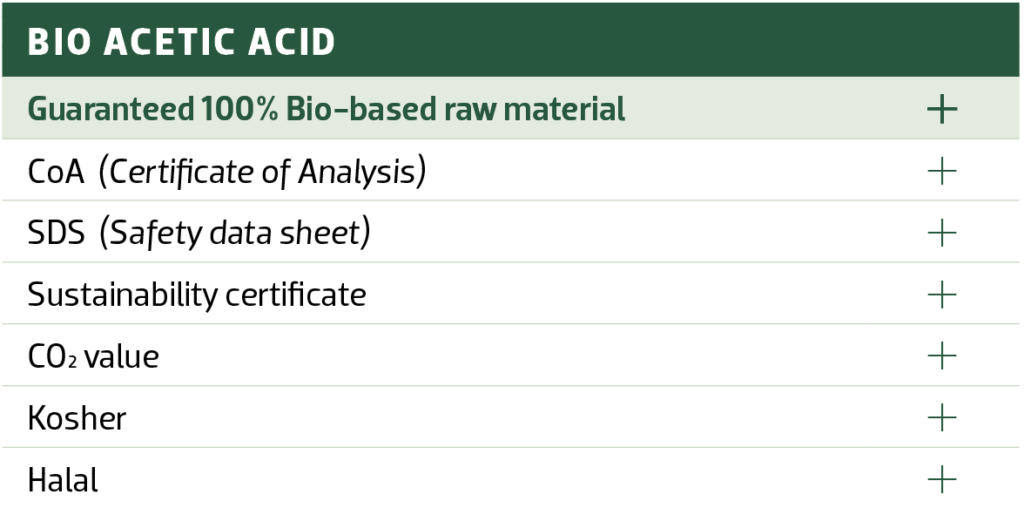
CoA. Certificate of Analysis certifies that a Batch or Lot of Product meets all established and mutually agreed upon Specifications as referenced, signed and dated by a duly authorized representative of the Quality Control or Quality Assurance Department.
SDS. The safety data sheet includes information such as the properties of each chemical; the physical, health, and environmental health hazards; protective measures; and safety precautions for handling, storing, and transporting the chemical.
Sustainability certificate. Our products are certified by ISCC+ which is a globally applicable sustainability certification system.
CO2 value. GHG value chain protocol to show greenhouse gas emission.
Kosher. This certification verifies that the production complies with the standards of kashrut (Jewish dietary law) as stipulated in the Shulchan Arukh, the benchmark of religious Jewish law.
Halal. A Halal certified product means that the product is permissible or acceptable in accordance with Islamic law.

Albert Bergström is Sales Manager at Sekab with a background in energy systems engineering and international sales. He works closely with customers across Europe to support the transition to bio-based chemicals and more sustainable industrial processes.