Bio Ethanol
PRODUCTS BY SEKAB

PRODUCTS BY SEKAB
Sekab supplies high-quality, bio-based ethanol to industrial customers across Europe. The feedstock is sourced from sustainably produced, renewable raw materials and is purified and further processed at our facility in Örnsköldsvik, Sweden.
As a fossil-free alternative to conventional ethanol, it offers lower climate impact, high traceability and secure supply, without compromising on technical quality. The bio-based ethanol is used both as a feedstock in our own production of fossil-free chemicals and sold as a pure product to customers within the European process industry. Sekab’s ethanol products are produced from premium second-generation ethanol based on residual streams from the Swedish forest industry.
Ethanol, also known as ethyl alcohol (C₂H₅OH), is an organic compound used across a wide range of technical and chemical applications. It functions as a solvent, a fuel component and an intermediate in various manufacturing processes.
Sekab works exclusively with certified, sustainable suppliers and ensures full traceability throughout the entire value chain – from raw material to finished product.
Ethanol is used across a broad range of industries, including paints and coatings, pharmaceuticals, cosmetics and packaging.
Sekab does not produce ethanol itself. Instead, we source sustainably produced, bio-based ethanol and further process and upgrade it.
At our facility, the ethanol is purified, dehydrated and treated to meet the specific quality and specification requirements of different industrial customers.
Established technology and long-standing operational experience ensure consistent quality and high purity for industrial applications.
Through advanced distillation and dehydration processes, we achieve the concentration levels required by the European process industry.
Bio-based ethanol is the feedstock for Sekab’s production of:
These products are used in paints, adhesives, food, pharmaceuticals, cosmetics, plastics and many other applications where demand for fossil-free alternatives is rapidly increasing.
Production in Örnsköldsvik is powered by renewable electricity and steam, with 100% fossil-free energy sources. Sekab is certified according to ISCC PLUS, ensuring traceability, sustainable feedstock sourcing and low climate impact throughout the entire production chain.
Sekab’s bioethanol is used as a renewable replacement for fossil-based raw materials in a wide range of industrial applications. It functions both as a feedstock and as a component in various chemical processes and products.
Bioethanol is used, among other things, for low-level blending into petrol and other fuel blends, helping to reduce climate impact and increase the share of renewable energy in the transport sector. It is also used in other blends such as Thermol and windscreen washer fluid, where it serves as an effective solvent.
A significant share of Sekab’s bioethanol is used as feedstock for the production of bio-based chemicals such as acetaldehyde, ethyl acetate and acetic acid. These chemicals are key components in many products within the chemical and manufacturing industries and have the same properties as their fossil-based equivalents.
All ethanol supplied by Sekab is produced from bio-based feedstock and meets the sustainability requirements under ISCC certification, ensuring full traceability and low climate impact throughout the production chain.
Bio-based ethanol delivers significantly lower climate impact compared to fossil-based alternatives. Combined with the fact that Sekab’s production is largely powered by renewable energy, our customers can reduce their climate footprint across Scope 1, 2 and 3.
This provides a competitive and commercially strong alternative for businesses that want to:

Ethanol is an alcohol used as a solvent, a fuel component and a feedstock in various manufacturing processes. Sekab’s bioethanol is bio-based and produced from residual streams from the Swedish forest industry.
Yes. Ethanol produced from biological material is classified as a renewable energy source. Sekab’s production is powered by green energy, further reducing its climate impact.
Ethanol is used for low-level blending in fuels and as a feedstock in the production of bio-based chemicals such as ethyl acetate, acetaldehyde and acetic acid.
Bioethanol only releases the amount of carbon dioxide previously absorbed by the plant material. This makes it an environmentally responsible choice for companies aiming to reduce their climate footprint.
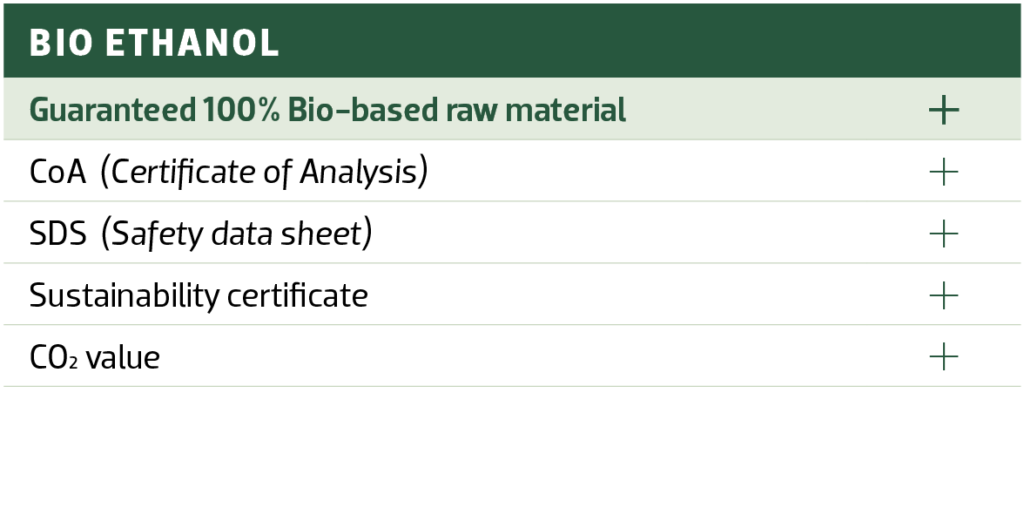
CoA. Certificate of Analysis certifies that a Batch or Lot of Product meets all established and mutually agreed upon Specifications as referenced, signed and dated by a duly authorized representative of the Quality Control or Quality Assurance Department.
SDS. The safety data sheet includes information such as the properties of each chemical; the physical, health, and environmental health hazards; protective measures; and safety precautions for handling, storing, and transporting the chemical.
Sustainability certificate. Our products are certified by ISCC which is a globally applicable sustainability certification system.
CO2 value. GHG value chain protocol to show greenhouse gas emission.
Technical ethanol is a common name fot high concentration ethanol, usually 95% or 99%, which can be provided with or without various denaturations. Technical ethanol has many uses and is commonly found in the production of, among other things, food, paints and antiseptic products and as an ingredient in environmentally friendly solvents.
Other uses include detergents, industrial paints, printing inks and in certain process industries. Sekab is extremely flexible when it comes to delivering technical ethanol and can meet many requirements in terms of concentration and denaturation. Today, for example, we provide mixtures with ethylacetate, methyl ethyl ketone, normalbutanol or isopropanol.
Biological ethanol is also a substance that is rapidly broken down in our natural environment, which also makes it an environmentally friendly choice; the ethanol becomes a part of the natural cycle and a good alternative both in terms of local environmental impact and emissions of fossil carbon dioxide.