Bio Ethyl acetate
PRODUCTS BY SEKAB

PRODUCTS BY SEKAB
Bio ethyl acetate from Sekab is used by industrial customers who want to reduce climate impact in their value chains by replacing fossil-based raw materials with bio-based alternatives. As a European producer, Sekab supplies bio ethyl acetate based on bio-based ethanol to customers within the European process industry.
The product is chemically identical to fossil-based ethyl acetate and has the same function and technical properties, but is based on renewable raw materials and produced using renewable bioenergy. Bio ethyl acetate can therefore be used as a drop-in solution in existing chemical processes.
Ethyl acetate is an organic chemical compound used in industrial and chemical processes where controlled properties and consistent quality are required. It functions as a solvent and as a chemical component in various applications and is well established within chemical value chains.
In its bio-based form, ethyl acetate has the same chemical structure and functionality as fossil-based ethyl acetate. The difference lies in the origin of the feedstock.
Ethyl acetate is formed through a chemical reaction in which ethanol and acetic acid react to form an ester. When bio-based ethanol is used as feedstock, the final product has the same chemical properties as conventional ethyl acetate, but with a renewable raw material origin.
This synthesis is a well-established chemical process used for the production of both fossil-based and bio-based ethyl acetate.
Sekab’s Bio Ethyl acetate is produced from 100% bio-based feedstock. The origin of the raw materials is traceable and verified through certification, ensuring that the product meets requirements for sustainable feedstock use throughout the entire value chain.
The bio-based feedstock provides the same technical properties as fossil-based alternatives. Bio-based ethyl acetate can therefore be used in existing industrial processes without the need for technical modifications.
Sekab provides verified climate calculations and CO₂ values that can be used in customers’ climate reporting.
Compared to fossil-based alternatives, bio-based ethyl acetate shows significantly lower CO₂ emissions, as demonstrated in the available climate documentation.
Ethyl acetate is used in industrial and chemical processes where solvents or chemical components with stable and controlled properties are required. Applications vary depending on the process and technical requirements.
Sekab supplies ethyl acetate directly to industrial customers. Enquiries are handled through direct dialogue regarding product specifications, volumes and delivery terms.
Pricing is influenced by factors such as feedstock selection, certification, quality, volumes and logistics. Prices are agreed in dialogue with the customer.
No. Bio-based ethyl acetate is chemically identical to fossil-based ethyl acetate. The difference lies in the origin of the raw material.
Traceability is ensured through certified feedstock and ISCC certification, documenting the origin of raw materials and the production chain.
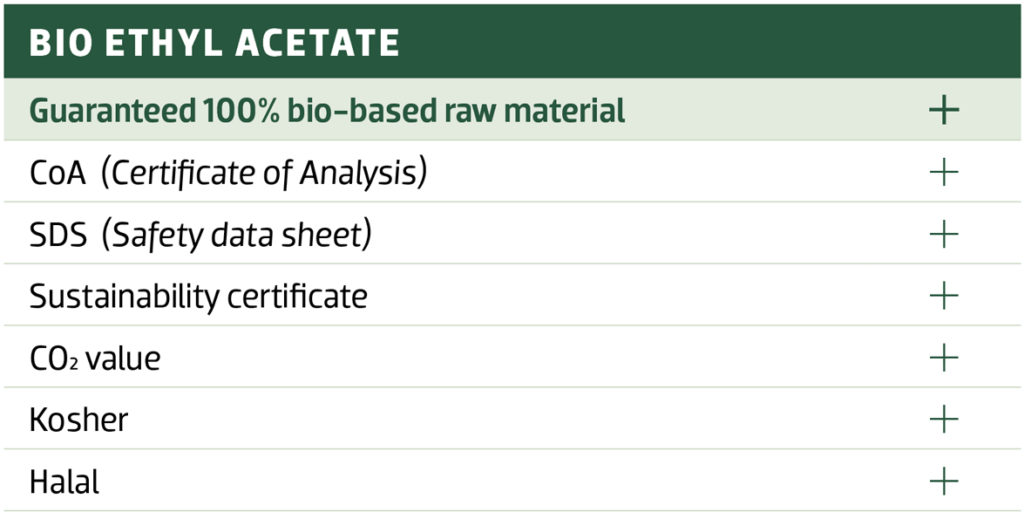
CoA. Certificate of Analysis certifies that a Batch or Lot of Product meets all established and mutually agreed upon Specifications as referenced, signed and dated by a duly authorized representative of the Quality Control or Quality Assurance Department.
SDS. The safety data sheet includes information such as the properties of each chemical; the physical, health, and environmental health hazards; protective measures; and safety precautions for handling, storing, and transporting the chemical.
Sustainability certificate. Our products are certified by ISCC+ which is a globally applicable sustainability certification system.
CO2 value. GHG value chain protocol to show greenhouse gas emission.
Kosher. This certification verifies that the production complies with the standards of kashrut (Jewish dietary law) as stipulated in the Shulchan Arukh, the benchmark of religious Jewish law.
Halal. A Halal certified product means that the product is permissible or acceptable in accordance with Islamic law.
Ethyl acetate is a solvent used in many contexts, including printing inks, varnishes and car care chemicals, and when manufacturing plastics and rubber. In the food industry, Ethyl acetate is used in the manufacture of flavourings and in the pharmaceutical industry as an extraction solvent in the production of pharmaceuticals. Ethyl acetate is also a common component of cosmetics and nail polish remover.
Ethyl acetate is considered to be one of the least environmentally harmful of organic solvents. It is very effective while it is easily broken down in both air and water.